What Is Generative AI?
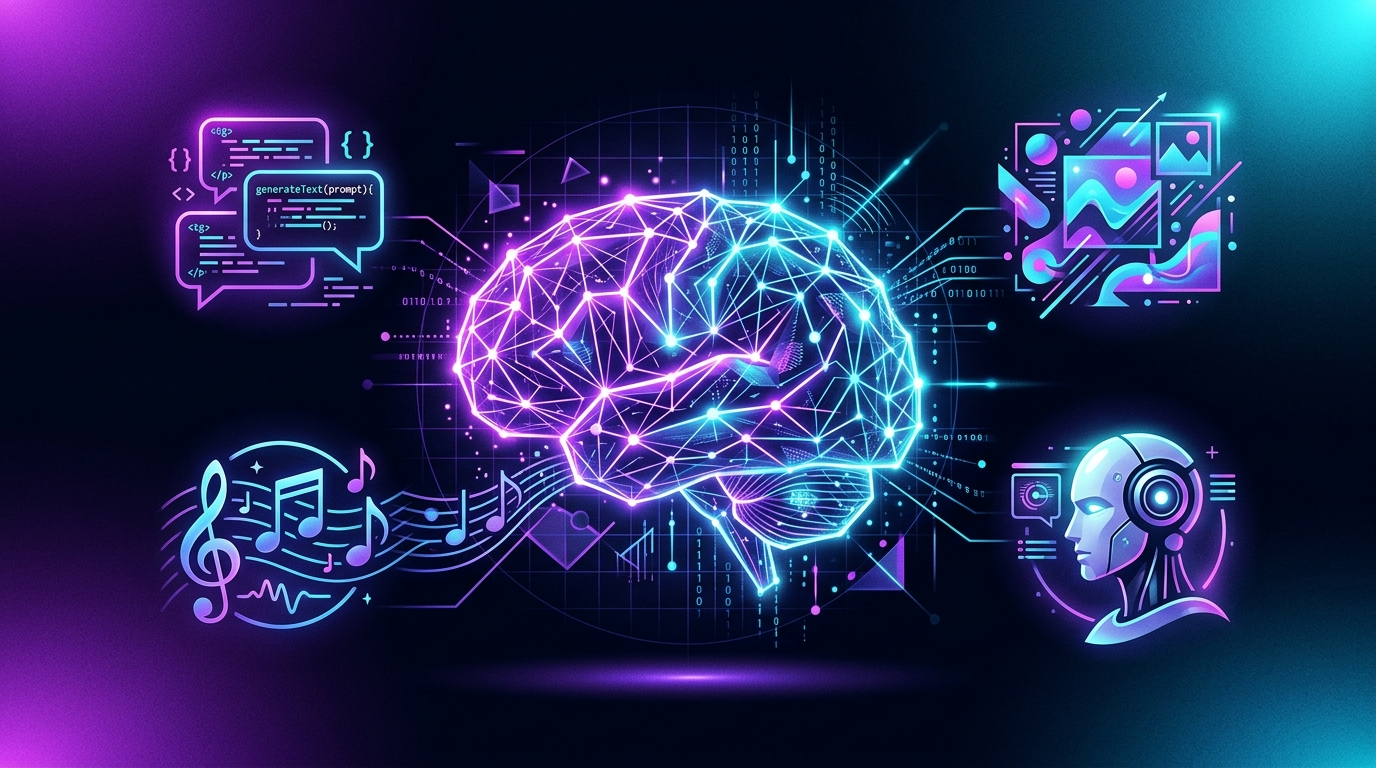
Generative AI is a category of artificial intelligence that can create new content — text, images, music, code, video, and more — by learning patterns from massive datasets and then generating statistically plausible outputs based on an input (called a prompt).
Unlike traditional AI that classifies or predicts (e.g., "Is this email spam? Yes/No"), generative AI produces something new that didn't exist before. Ask it to write a poem about black holes, generate a photorealistic image of a cat surfing, or summarize a 200-page legal document — it delivers.
Think of it like a student who reads thousands of books, then writes their own book in the same style. The content is new, but the patterns (grammar, vocabulary, narrative structure) come from everything they've absorbed.
Four Core Types of Generative AI Output
How Does Generative AI Work?
Under the hood, most generative AI systems are built on neural networks — computational graphs loosely inspired by the human brain. These networks have billions of numerical parameters (weights) that are tuned during training so the model learns what outputs are "good".

Stage 1: Training on Massive Data
The model ingests an enormous dataset. For language models like GPT-4, this is hundreds of billions of words from books, websites, code repositories, and scientific papers. For image models, it's hundreds of millions of image-caption pairs.
Stage 2: Learning Patterns (The Training Loop)
During training, the model tries to predict what comes next. For text: given "The capital of France is…" it should output "Paris". It gets a score (loss), and updates its billions of weights using backpropagation and gradient descent — a mathematical way of nudging the model's guesses toward the correct answer, millions of times per second.
Stage 3: Generation (Inference)
At inference time, you give the model a prompt. It uses its learned weights to predict the most plausible continuation — token by token. A "token" is roughly a word or word-piece. The model samples from a probability distribution to choose each token, introducing controlled randomness for creative variety.
The Key Technologies Behind GenAI
Transformers: The Architecture That Changed Everything
In 2017, Google researchers published "Attention Is All You Need", introducing the Transformer architecture. The key idea: Attention mechanisms — a way for the model to dynamically focus on the most relevant parts of the input when generating each output token.
When you read "The trophy didn't fit in the bag because it was too big," your brain knows "it" refers to the trophy. Attention mechanisms teach AI to resolve these references by learning which words are most related to each other.
Large Language Models (LLMs)
LLMs are transformer-based models trained on text at enormous scale. GPT-4 has an estimated 1 trillion+ parameters trained on trillions of tokens — unlocking emergent capabilities like complex reasoning and code generation that weren't explicitly programmed.
Diffusion Models (for Images)
Image generators like Stable Diffusion and DALL·E use diffusion — the model learns to remove noise from images gradually. At generation time, it starts with pure random noise and iteratively denoises it, guided by your text prompt.
Real-World Examples You Already Know
| Product | Company | What It Generates | Technology |
|---|---|---|---|
| ChatGPT | OpenAI | Text, code, analysis | GPT-4 (LLM) |
| Gemini | Text, images, audio, video | Gemini 1.5 Pro | |
| DALL·E 3 | OpenAI | Photorealistic images | Diffusion + CLIP |
| Claude | Anthropic | Text, summarization, coding | Constitutional AI (LLM) |
| GitHub Copilot | GitHub / Microsoft | Code autocompletion | Codex (LLM) |
| Suno | Suno AI | Full songs with vocals | Audio diffusion model |
A Brief Timeline of Generative AI
Important Limitations to Know
Generative AI is powerful, but it's far from perfect. Understanding its limits makes you a smarter, safer user.
When using AI-generated content in professional, medical, legal, or financial contexts, always have a human expert review the output. AI can be wrong — even when it sounds very confident.
🧠 Test Your Knowledge
Let's see what you've learned! Answer these quick questions:
What to Learn Next
You now understand the fundamentals of Generative AI! Here's what to explore next.